16Jul

Case Number: 001 

Capture Date: July 4, 2026 

Platform & Context: Facebook Comment 

Part 2: AI speculations

In part 1 of this case study, we looked at the tip of the proverbial iceberg, the most obvious AI hallucinations and falsifications that anyone could easily check against readily available, credible sources. These include the omission of the time periods in which the authors were writing and the failure to identify each author’s legal school, which completely undermines AI’s claim about “the dominant opinion” spanning “more than a millennium.” If you have not read it, you can find it here. 

In this post, we will dive into the ocean of the sources and reveal the iceberg itself: the ways a shallow AI summary misrepresents the texts by stripping away the complex and nuanced discussions of classical scholars like al-Tabari, allowing people to project an illusion of deep reading while exerting zero intellectual effort. 

Classical Islamic scholarship was not merely a database of opinions; it was an argumentative tradition in which scholars disagreed, qualified claims, ranked evidence, and situated interpretations within schools. As we saw in Part 1, AI listed four Tafsir authors representing only two of the four surviving Sunni schools of thought and one other extinct school. Let’s examine the alleged quotes together to see what they include and what they omit. 

The first thing we see omitted is the words of the Quran. Yet the actual verse or verses of the Quran are the first thing every commentator writes. Every commentator begins with the verse or verses they will discuss. Individual parts of verses are discussed in the context of the whole verse, as well as other related verses of the Quran. Many also include detailed discussion of the circumstances in which Muslim tradition says the verse or verses were revealed.

 AI begins its list with Ibn Kathir. His full name is Abū al-Fidā' Ismā'īl ibn 'Umar ibn Kathīr. He was a Sunni of the Shafi’i school of law who lived in the 14th century of the Common Era (CE). He died in 1373 CE, 774 years after Muhammad’s migration from Mecca to Medina. This makes Ibn Kathir closer in time to us than to the time of Muhammad. 

When we read Ibn Kathir’s commentary, AI’s one-sentence quote completely omits the context in which it occurs. The title of the chapter is “Divorce” and all 12 verses give direct guidance on how to safeguard the rights of divorced women. The quote is taken from Ibn Kathir’s in-depth discussion of verses 4 and 5 that deal with the required time divorced women must wait to remarry if they do not menstruate, their menstruation is irregular, or if they are pregnant. The verse specifies a three-month waiting period for “those of your women who have reached menopause” and “those who do not menstruate.” Ibn Kathir states that the latter includes “those who have not reached the age of menstruation.” This is not the topic that gets the most attention from Ibn Kathir, however. His treatment of the phrase “if you are in doubt,” which comes just before the statement that the waiting period is three months, is much more detailed. Ibn Kathir notes that Muslims disagreed on whether the doubt was related to whether bleeding was menstrual or non-menstrual blood, or whether the doubt was about the waiting period itself. The topic of doubt and the comparison of the waiting period of pregnant divorcees with the waiting period of pregnant widows get the most attention from Ibn Kathir. 

The next author the Synthetic Sheikh lists is the earliest, al-Tabari (d. 923 CE), who lived 450 years before and about 300 years after Muhammad’s migration from Mecca to Medina. Al-Tabari lived after the major Sunni collections of Hadith were compiled, and he made extensive use of Hadith in his commentary on the Quran. His commentary is more extensive than Ibn Kathir. Like Ibn Kathir, al-Tabari’s focus is on the meaning of the phrase “if you are in doubt” and includes the various reasons that a woman’s menstrual cycles might be in doubt, from irregular periods to non-menstrual bleeding; and like Ibn Kathir, al-Tabari mentions “those who have not menstruated because they are young” along with “those young women whose menstruation has ceased. There is also a detailed comparison of the waiting period of pregnant divorcees and pregnant widows. 

The third author in AI’s list is al-Qurtubi. Abū ʿAbdullāh Muḥammad ibn Aḥmad ibn Abī Bakr al-Anṣārī al-Qurṭubī lived, as his name indicates, in Cordoba in the 13th century. He died in the year 1273 of the Common Era (CE), 671 years after Muhammad’s migration from Mecca to Medina. He was a Sunni of the Maliki school of law. Again, the AI list extracts a single sentence to imply that child marriage contracts were the central thematic focus of commentary on this verse. In reality, al-Qurtubi’s Al-Jami' li-Ahkam al-Qur'an is an extensive, legalistic work. For Surah At-Talaq, verse 4, al-Qurtubi organizes his analysis into specific legal questions (masā'il). His primary, in-depth focus is on the strict procedural mechanics of divorce, financial maintenance, and the definitions of menopausal biology. His statement that “those who do not menstruate” refers to “those who have not reached the age of menstruation” is simply included to ensure all possibilities are legally covered regarding the 'iddah (waiting period). By extracting this specific statement and stripping away the legal framework surrounding it, the AI creates a distorted view. It makes it seem as though al-Qurtubi was defending child marriage, when he was actually writing a commentary detailing the legal and financial protections due to a woman during a divorce.


The final commentary listed is that of the two Jalals (Tafsir al-Jalalayn, in Arabic). The work was begun by Jalal ad-Din al-Maḥalli (d. 1459 CE) and completed after his death by Jalal ad-Din as-Suyuti (d. 1505 CE). This is the most concise of all the commentaries in the list. Here too, we see that the authors include those who do not menstruate because of their young age in the larger category of women who do not menstruate or whose menstruation is in doubt. 

When we look at this sequence, jumping from the 14th century (Ibn Kathir), back to the 10th (al-Tabari), forward to the 13th (al-Qurtubi), and ending in the 16th (Jalalayn), the structural chaos exposes a definitive machine-generated fingerprint. A human scholar would  order these authors chronologically to track the historical evolution of the commentary, or group them by their legal and methodological schools. The AI bypassed both human systems because it operates strictly on statistical web-search popularity clusters. In the AI's training data, these specific four Tafsirs are the most heavily translated and cross-referenced in English online polemics. The algorithm didn't plan a logical historical sequence; it simply generated a chronologically chaotic list based on how often these names appear next to each other on scraped internet debate forums. This is a textbook example of what forensic linguistics calls algorithmic flattening, where the deep, multi-tiered timeline of human scholarship is sanded down into a uniform, parallel block of machine slop. 

The critical error the AI commits here is not a failure of literal accuracy; the quotes themselves can be found in the texts. The deception is a failure of thematic proportionality. By extracting these isolated statements and presenting them in a flat, uniform list, the algorithm performs a profound decontextualization. It transforms a single potential situation within massive, multi-tiered legal and procedural discussions into the alleged 'focus' of these authors' entire commentaries on the verse. It allows an online polemicist to project an illusion of deep reading, when in reality, the machine has simply blinded them to what these scholars were actually discussing. What AI has also completely excluded are the opinions of contemporary scholars, such as those at al-Azhar, the Sunni world’s premiere center of religious learning, who have explicitly ruled against child marriage. Muslims have always read and interpreted the Quran within their own social and historical context.
Baca Lagi  
04Jul

Ini merupakan catatan sulung siri Synthetic Sheikhs: The Ink vs. The Algorithm. Ia menunjukkan dan merungkai halusinasi AI, keterlaluan dan dakwaan palsu dalam komen Facebook tentang Al-Quran 65:4.


 Case Number: 001

Capture Date: July 4, 2026

Platform & Context: Facebook Comment

Part 1: The Most Obvious Errors

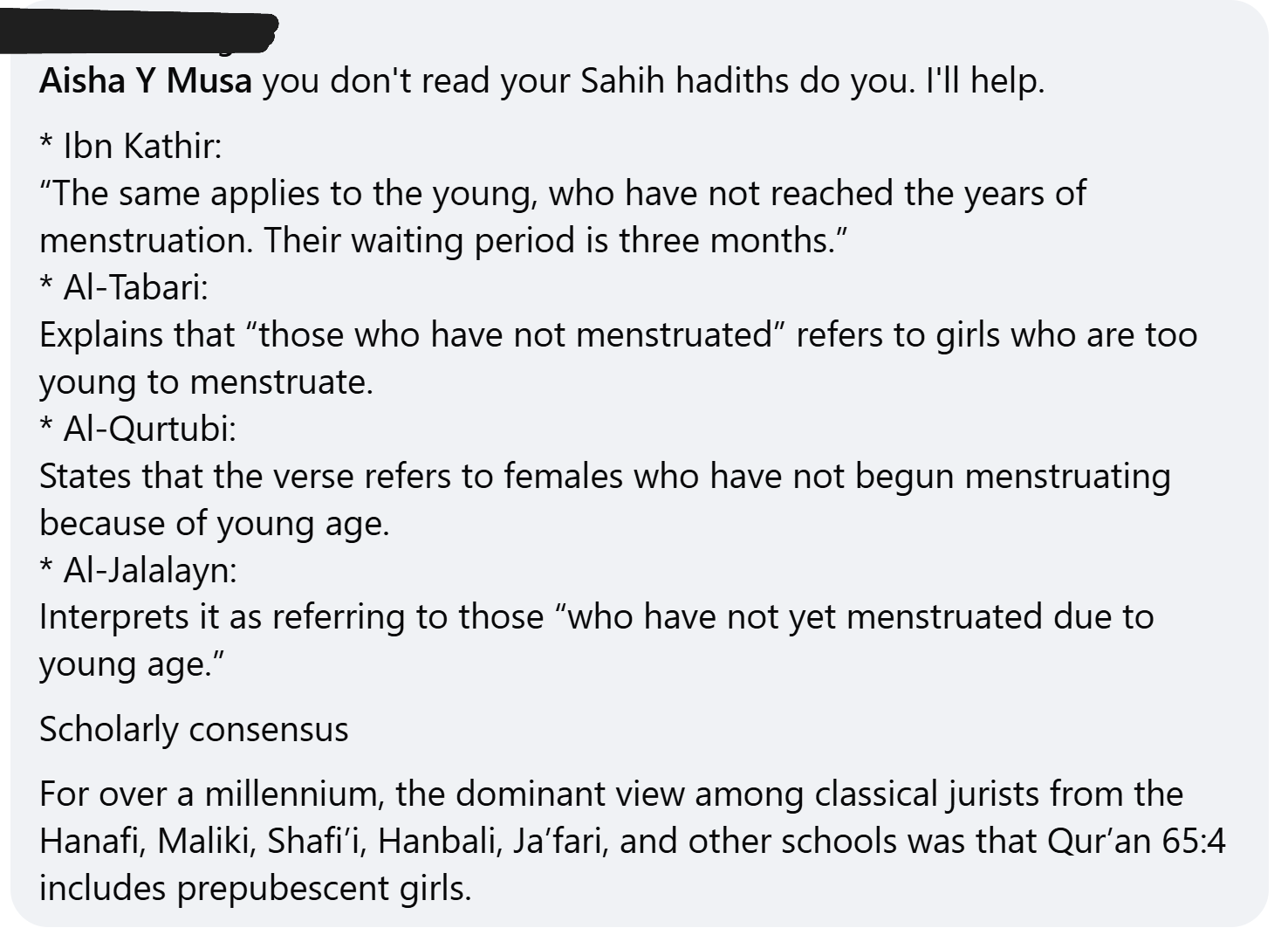
The post below combines an opening line written by the person posting it, followed by what is clearly AI generated slop. We can tell the difference by looking at both writing style and the kind of errors that are in the text. The opening line has errors that show us that it was written by a person who does not know what they are talking about. The first error is punctuation. We know it is written by a person because they use incorrect punctuation. For this sentence to be grammatically correct, it requires a comma after “hadith” and a question mark rather than an period after “do you”. This is the kind of writing error is distinctly human. The error that shows us that the writer does not know what they are talking about is that they mention “sahih hadith,” but then post an AI generated list of Tafsir (Quranic commentary) scholars. Quranic commentaries and Hadith are completely different genres of Islamic religious literature. The opinions and explanations offered by the authors of Quranic commentaries are not “sahih hadith.” 


Turning to the list of Quranic commentators and their alleged opinions, we see clear signs that it was generated by AI. The first sign is the use of single short declarative sentences that homogenize four completely distinct classical scholars into a bullet pointed list to create the illusion of uniformity. This kind of homogenization is typical of AI generated content. The next sign of AI generations is the use of the vague cliché “For over a millennium,” to begin the concluding paragraph. Like the single declarative sentences in a homogenized bullet pointed list the use of cliches is typical of AI usage. The cliché itself also does not match the four commentators in the homogenized list. The commentators in the list span less than 600 years. Tabari (d. 923 CE) is the earliest, followed by Qurtubi (d. 1273) CE, followed by Ibn Kathir (d. 1373 CE), and finally Jalalayn (d. 1505 CE). Looking at the years, we see that three of the four commentators lived within less than 300 hundred years of each other.


 The opening cliché is  followed by a broad and general claim about the dominant view of classical jurists and an Oxford comma listing of the Sunni schools and one Shi’ite school, and “other schools.” But this nearly comprehensive list of schools is not represented in the homogenized list generated by AI. All four commentators are Sunni and as already noted, the majority are less than 300 years apart. 


AI has hallucinated both the claim that the opinion spans “more than a millennium,” and the claim that is the dominant view of jurists of the “Hanafi, Shafi’i, Maliki, Hanbali, Ja’fari, and other schools.” Of the four commentators in the bullet pointed list Ibn Kathir and Jalalayn are Shafi’I school; Qurtubi is Maliki, and Tabari is associated with his own school, the Jariri. Only two of the four surviving Sunni schools of law are cited, together with one “other” school. 


These particular hallucinations, exaggerations, and false claims are only the obvious tip of the proverbial iceberg. The person who posted the comment could have easily checked and found the errors but chose not to do so. The problem of flattening and homogenizing the content of the commentaries themselves through selective quoting and/or misquoting is the iceberg itself. We will dive into that in Part 2.


Baca Lagi  
09Feb

Adakah suara-suara terkemuka dalam gerakan "kontra-jihad" sebenarnya mengukuhkan dakwaan ideologi pelampau yang mereka lawan?

Some Westerners facilitate “Islamic terror” directly, by providing material support, like Jihad Jane. Others, however, facilitate it indirectly, by opposing it in a way that gives it legitimacy. Take Steven Coughlin, for example. Coughlin is an American lawyer and former Joint Chiefs of Staff intelligence analyst who has written several books about Islam., People like Coughlin covertly provide support for Islamic terror while overtly speaking against it. They are part of what Nathan Lean calls The Islamophobia Industry (Pluto Press, 2012).

The authors and activists who make up this industry include the U.S. Secretary of Defense, Pete Hegseth; British firebrand, Tommy Robinson; and author Sam Harris. All of them use a particular framework to support terrorism as legitimately Islamic. That framework consists of: 1) using key terms in Arabic such as jihad, sharia, and fatwa; 2) using the theory of abrogation to dismiss all interpretations of jihad that do not involve the use of force; 3) ignoring the way that the majority of Muslim scholars and lay people have understood these terms for more than 1200 years while focusing on a limited number of works that support the meaning they champion; and 4) dismissing the all positive interpretations as disingenuous apologetics. While this often has the effect of generating fear of Islam and Muslims among the general public, it also (somewhat perversely) champions and encourages the most violent interpretations of Islamic sources.


For example, in Islam and the Future of Tolerance, Sam Harris states that “groups like Islamic State and al-Qaeda are enacting very literal (and therefore plausible) interpretations of Islamic doctrine” (Kindle edition, 115). Describing some religious interpretations as “very literal” and “plausible” while dismissing other interpretations as “acrobatic” and “reformist” (114) is a theological claim that asserts the religious legitimacy of the former over the latter. Likewise, Stephen Coughlin argues in Catastrophic Failure: Blindfolding America in the Face of Jihad, that Islamic terrorism “seamlessly merges Islamic Law through the doctrine of abrogation” (Kindle edition, 166). Both Harris and Coughlin rely on a narrow view of the highly contested concept of abrogation, but that is just one of many misleading aspects of their works dealing with Islam. Harris cites few sources in Islam and the Future of Tolerance, which is a relatively short work written as a dialogue between Harris and Maajid Nawaz, founder of the now defunct Quilliam Foundation. By contrast, Coughlin’s Catastrophic Failure is a long work containing copious citations. At first glance, this seems like an impressive piece of scholarship. However, a close examination of the sources cited by Coughlin shows that his work is a carefully stacked deck built by meticulously selecting only those sources (and particular parts of those sources) that support the claims he makes. Thispost will focus on Coughlin’s Catastrophic Failure.

The issues with Coughlin’s work are too many and too serious to address in this brief post, so I will deal with only two of the most egregious issues: 1) the highly selective use of limited sources; 2) the erroneous claims about the concepts of consensus (ijma) and abrogation (naskh) that arise from that highly selective use.

Early in the book, Coughlin says, “The United States is currently fighting this war according to the Barnes and Noble Standard. That is, every insight into the enemy’s threat derives from sources no deeper than an introductory book from Barnes and Noble” (Catastrophic Failure, Kindle edition, 668). The analogy he uses to illustrate the “Barnes and Noble Standard” is someone being confident that they can perform brain surgery because they “just went to Barnes and Noble yesterday and got this cool book on neurosurgery” (Coughlin, Kindle edition, 676). The difference between Coughlin and his imaginary brain surgeon is that instead of Barnes and Noble, Coughlin goes to an Islamic bookstore, where he gets an English translation of a book on Islamic law. The book is a 14th century reference manual, Reliance of the Traveller and Tools of the Worshipper, meant to aid worshippers in daily life and practice. This is clear from the fact that most of the book deals with daily practices such as cleanliness, prayer, charity, and fasting, as well as interpersonal issues related to marriage, divorce, inheritance, business relationships and trade (Table of Contents, Reliance). Comparing this to his Barnes and Noble analogy, the work is not even equivalent to an introduction to neurosurgery. Instead, it is a first aid manual. Using it to argue that Islamic terrorism “seamlessly merges Islamic Law through the doctrine of abrogation” is like using a first aid manual to do brain surgery. This general reference manual written to help the average lay Muslim with day-to-day life is the one book Coughlin cites more than any other in support of his claims.

In addition to Reliance of the Traveller and Tools of the Worshipper, Coughlin cites English translations of two other 14th century works. One of those is Ibn Khaldun’s (d. 1406) Muqaddimah. The Arabic word muqaddim means “introduction,” and this book is the Introduction to Ibn Khaldun’s multivolume history of the world. Ibn Khaldun was a historian and philosopher. He was not a legal scholar or theologian, and the Muqaddimah is not an authoritative work on Islamic Law. Returning to the Barnes and Noble analogy, using the Muqaddimah to support the claim that terrorism, or anything else for that matter, “seamlessly merges with Islamic Law” is like doing brain surgery after reading the introduction to a general history of medicine.

The third 14th century work cited by Coughlin is the Quranic commentary (tafsir) of Ibn Kathir (d. 1373). This and the 15th century commentary, Tafsir Jalalayn are the only premodern commentaries he uses. There are nearly 3,000 Quran commentaries that have survived in manuscript since middle of the second century after the time of Muhammad, and of these some 300 of the most highly respected and authoritative have been published in print (Ross, “State of tafsīr Studies”), yet to support his claims about how Muslims have historically understood the Quran, Coughlin uses only two commentaries out of hundreds spanning more than eight centuries from the time of Muhammad (d. 632) to the time of Jalalayn (d. 1505).

In addition to this narrow selection of classical Islamic texts, Coughlin also relies on a few contemporary works, but like Reliance of the Traveller and the Muqaddimah, those works are general introductions rather than comprehensive advanced works on Islamic doctrine and law. These include Asaf A. A. Fyzee’s Outlines of Muhammadan Jurisprudence that deals with law in India and Pakistan in in the mid twentieth century and is a brief systematic textbook “written for the elementary student” (Fyzee, v, ix); Imran Ahsan Khan Nyazee’s Islamic Jurisprudence is written “ to educate people of a variety of academic levels in Islamic Jurisprudence” (Ansari, “Foreword” to Islamic Jurisprudence, xx), and his Theories of Islamic Law: The Methodology of Ijtihad is also a textbook written to “help lay readers, lawyers, and university students to understand Islamic jurisprudence” (Ansari, Foreword to Theories of Islamic Law, vi); Mohammed Hashim Kamali’s Principles of Islamic Jurisprudence is a textbook intended for university students “who seek to acquire an intermediate to advanced level of proficiency in this subject” (Kamali, xvi).


It is ironic that after citing Imran Nyazee’s Theories of Islamic Coughlin concludes that “a non-Muslim cannot just pick up a book on Islamic Law and decide for himself what it means” (Coughlin 883) – and then goes on to do precisely that throughout Catastrophic Failure! In other words, Coughlin himself is guilty of using the very “Barnes and Noble Standard,” that he condemns. He picks up introductory and intermediate books on Islamic Law, decides for himself what they mean, and then carefully stacks the deck by selectively quoting from the sources and leaving out information that challenges his claims.


Likewise, Coughlin quotes from Reliance of the Traveller that scholarly consensus refers to “a ruling agreed upon by all mujtahids in the Islamic community” (Kindle edition, 912). Coughlin uses bold and italics to emphasize this criterion. He then cites Nyazee as affirming the continuing status of ijma: “The majority of jurists agreed” that if there is explicit ijma on an issue it becomes obligatory and cannot be opposed (Kindle edition, 923). Yet Coughlin ignores the clear criterion he has just emphasized and seems oblivious to the distinction between something that is agreed upon by all and something that is only agreed upon by the majority. He also fails to mention that Nyazee explicitly states that there were those who disagreed with the majority and argued that ijma is not a binding source, and that the “majority, who upheld ijma’ as a binding source, as well as those who opposed them on this issue argued on the basis of the Qur’an and the Sunnah” (Nyazee, Jurisprudence, 187-188). Nyazee then outlines the arguments of both the majority and the minority and states that the arguments of the majority are considered stronger (Nyazee, Jurisprudence, 189). While the majority arguments may be considered stronger, Nyazee’s presentation shows that there was no scholarly consensus on the binding nature of consensus. This is because the explicit criterion necessary for consensus to be binding is it must be “agreed upon by all mujtahids” of the community, not merely “the majority.”

Kamali puts it this way: 

 The classical definition and the essential requirements of ijmā‘, as laid down by the ᶜulamā’ of uṣūl, are  categorical on the point that nothing less than a universal consensus of the scholars of the Muslim  community as a whole can be regarded as conclusive ijmā‘. There is thus no room whatsoever for disagreement, or ikhtilāf, within the concept of ijma‘. The theory of ijma‘ is equally unreceptive to the idea of relativity or a preponderance of agreement within its ranks. (Kamali, Islamic Jurisprudence, 228)

To support his claims about abrogation in the Quran, Coughlin cites 2:256: “Let there be no compulsion in religion: Truth stands out clear from Error: whoever rejects evil and believes in Allah hath grasped the most trustworthy handhold. (Qur’an 2:256)” (Kindle edition, 1650). Coughlin uses bold type to emphasize the phrase that he believes is abrogated by the verse he cites immediately following his quote of Quran 2:256, where he again highlights part of the verse in bold: “Whoever seeks a religion other than Islam will never have it accepted of him, and he will be of those who have truly failed in the hereafter (Qur’an 3:85).” His claim is the highlighted portion of Quran 2:256 is abrogated by the highlighted portion of Quran 3:85, but the Quran commentaries that Coughlin says he has used contradict his claim.

In his lengthy commentary on Quran 2:256, Ibn Kathir does not mention that it has been abrogated (Tafsir Ibn Kathir, vol. 002 Baqarah II, 263-264). Likewise, in his commentary on Quran 3:85, Ibn Kathir does not say that it has abrogated Quran 2:256. He explains that Quran 3:85 means all the prophets and messengers brought the same religion, submission to God (Tafsir Ibn Kathir, vol. 003 Imran, 130). Tafsir Jalalayn also does not say Quran 2:256 was abrogated by any other verse. What it says is that it was revealed about Muslims in Medina who tried to force their children to accept Islam (Tafsir Jalalayn, 41). Likewise, Tafsir Jalalayn does not say that Quran 3:85 abrogates any other verse. It explains that the verse was revealed about those who apostatized, saying what will happen to them in the hereafter (Tafsir Jalalayn, 58).

A careful examination of the sources of Coughlin says he has used indicates that either he has not read those sources with care, or that he has intentionally omitted relevant information from those sources that directly contradict his conclusion that terrorism “seamlessly merges with Islamic Law through the doctrine of abrogation.” Is this simply carelessness on Coughlin’s part, or has he intentionally stacked the deck? Either way, the result is the same: He has reached a conclusion that will stoke fear of Islam and Muslims among readers who trust him, while giving aid, comfort and encouragement to groups and individuals who are looking for an excuse to commit terrorist acts in the guise of religion. 

Coughlin is just one clear example of the limited and selective use of classical Muslim sources that gives aid and comfort to those who need to see their violence as righteous, begging the question: Whose side are they on?


Baca Lagi