Synthetic Sheikhs: The Ink vs. The Algorithm, Case Study 001-Part 1
Case Number: 001
Capture Date: July 4, 2026
Platform & Context: Facebook Comment
Part 1: The Most Obvious Errors
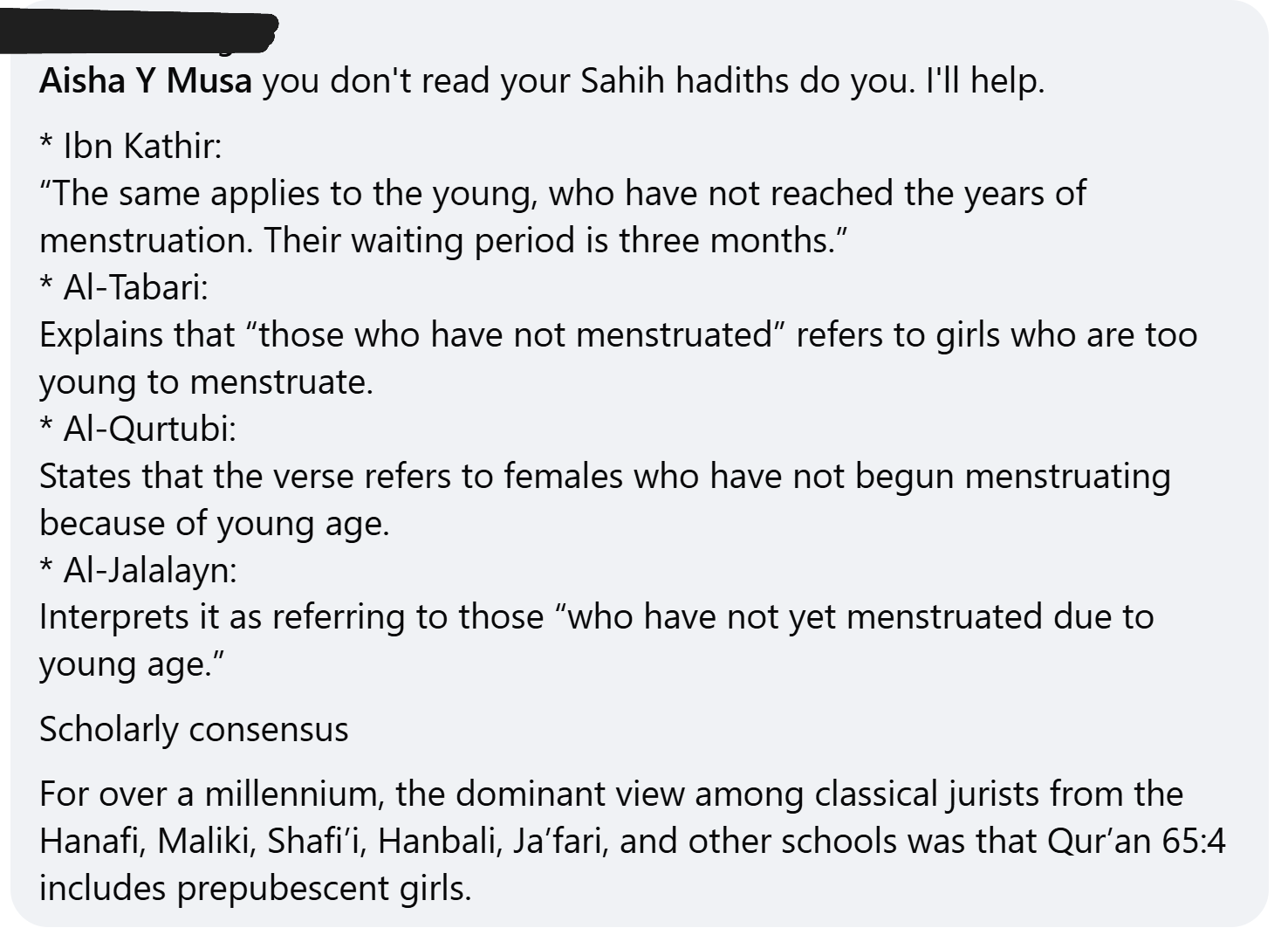
The post below combines an opening line written by the person posting it, followed by what is clearly AI generated slop. We can tell the difference by looking at both writing style and the kind of errors that are in the text. The opening line has errors that show us that it was written by a person who does not know what they are talking about. The first error is punctuation. We know it is written by a person because they use incorrect punctuation. For this sentence to be grammatically correct, it requires a comma after “hadith” and a question mark rather than an period after “do you”. This is the kind of writing error is distinctly human. The error that shows us that the writer does not know what they are talking about is that they mention “sahih hadith,” but then post an AI generated list of Tafsir (Quranic commentary) scholars. Quranic commentaries and Hadith are completely different genres of Islamic religious literature. The opinions and explanations offered by the authors of Quranic commentaries are not “sahih hadith.”
Turning to the list of Quranic commentators and their alleged opinions, we see clear signs that it was generated by AI. The first sign is the use of single short declarative sentences that homogenize four completely distinct classical scholars into a bullet pointed list to create the illusion of uniformity. This kind of homogenization is typical of AI generated content. The next sign of AI generations is the use of the vague cliché “For over a millennium,” to begin the concluding paragraph. Like the single declarative sentences in a homogenized bullet pointed list the use of cliches is typical of AI usage. The cliché itself also does not match the four commentators in the homogenized list. The commentators in the list span less than 600 years. Tabari (d. 923 CE) is the earliest, followed by Qurtubi (d. 1273) CE, followed by Ibn Kathir (d. 1373 CE), and finally Jalalayn (d. 1505 CE). Looking at the years, we see that three of the four commentators lived within less than 300 hundred years of each other.
The opening cliché is followed by a broad and general claim about the dominant view of classical jurists and an Oxford comma listing of the Sunni schools and one Shi’ite school, and “other schools.” But this nearly comprehensive list of schools is not represented in the homogenized list generated by AI. All four commentators are Sunni and as already noted, the majority are less than 300 years apart.
AI has hallucinated both the claim that the opinion spans “more than a millennium,” and the claim that is the dominant view of jurists of the “Hanafi, Shafi’i, Maliki, Hanbali, Ja’fari, and other schools.” Of the four commentators in the bullet pointed list Ibn Kathir and Jalalayn are Shafi’I school; Qurtubi is Maliki, and Tabari is associated with his own school, the Jariri. Only two of the four surviving Sunni schools of law are cited, together with one “other” school.
These particular hallucinations, exaggerations, and false claims are only the obvious tip of the proverbial iceberg. The person who posted the comment could have easily checked and found the errors but chose not to do so. The problem of flattening and homogenizing the content of the commentaries themselves through selective quoting and/or misquoting is the iceberg itself. We will dive into that in Part 2.