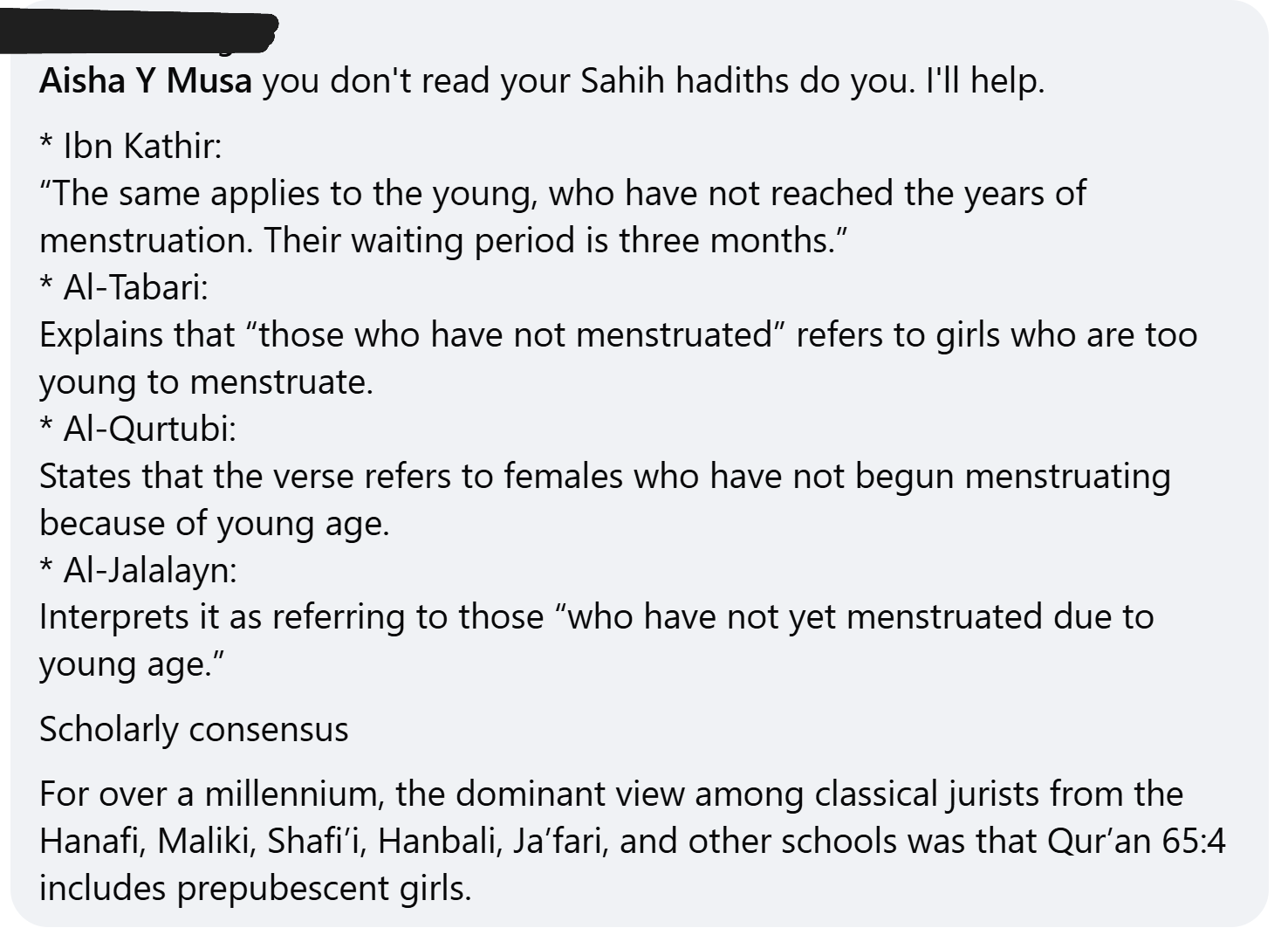
Case Number: 001
Capture Date: July 4, 2026
Platform & Context: Facebook Comment
Part 2: AI speculations
In part 1 of this case study, we looked at the tip of the proverbial iceberg, the most obvious AI hallucinations and falsifications that anyone could easily check against readily available, credible sources. These include the omission of the time periods in which the authors were writing and the failure to identify each author’s legal school, which completely undermines AI’s claim about “the dominant opinion” spanning “more than a millennium.” If you have not read it, you can find it here.
In this post, we will dive into the ocean of the sources and reveal the iceberg itself: the ways a shallow AI summary misrepresents the texts by stripping away the complex and nuanced discussions of classical scholars like al-Tabari, allowing people to project an illusion of deep reading while exerting zero intellectual effort.
Classical Islamic scholarship was not merely a database of opinions; it was an argumentative tradition in which scholars disagreed, qualified claims, ranked evidence, and situated interpretations within schools. As we saw in Part 1, AI listed four Tafsir authors representing only two of the four surviving Sunni schools of thought and one other extinct school. Let’s examine the alleged quotes together to see what they include and what they omit.
The first thing we see omitted is the words of the Quran. Yet the actual verse or verses of the Quran are the first thing every commentator writes. Every commentator begins with the verse or verses they will discuss. Individual parts of verses are discussed in the context of the whole verse, as well as other related verses of the Quran. Many also include detailed discussion of the circumstances in which Muslim tradition says the verse or verses were revealed.
AI begins its list with Ibn Kathir. His full name is Abū al-Fidā' Ismā'īl ibn 'Umar ibn Kathīr. He was a Sunni of the Shafi’i school of law who lived in the 14th century of the Common Era (CE). He died in 1373 CE, 774 years after Muhammad’s migration from Mecca to Medina. This makes Ibn Kathir closer in time to us than to the time of Muhammad.
When we read Ibn Kathir’s commentary, AI’s one-sentence quote completely omits the context in which it occurs. The title of the chapter is “Divorce” and all 12 verses give direct guidance on how to safeguard the rights of divorced women. The quote is taken from Ibn Kathir’s in-depth discussion of verses 4 and 5 that deal with the required time divorced women must wait to remarry if they do not menstruate, their menstruation is irregular, or if they are pregnant. The verse specifies a three-month waiting period for “those of your women who have reached menopause” and “those who do not menstruate.” Ibn Kathir states that the latter includes “those who have not reached the age of menstruation.” This is not the topic that gets the most attention from Ibn Kathir, however. His treatment of the phrase “if you are in doubt,” which comes just before the statement that the waiting period is three months, is much more detailed. Ibn Kathir notes that Muslims disagreed on whether the doubt was related to whether bleeding was menstrual or non-menstrual blood, or whether the doubt was about the waiting period itself. The topic of doubt and the comparison of the waiting period of pregnant divorcees with the waiting period of pregnant widows get the most attention from Ibn Kathir.
The next author the Synthetic Sheikh lists is the earliest, al-Tabari (d. 923 CE), who lived 450 years before and about 300 years after Muhammad’s migration from Mecca to Medina. Al-Tabari lived after the major Sunni collections of Hadith were compiled, and he made extensive use of Hadith in his commentary on the Quran. His commentary is more extensive than Ibn Kathir. Like Ibn Kathir, al-Tabari’s focus is on the meaning of the phrase “if you are in doubt” and includes the various reasons that a woman’s menstrual cycles might be in doubt, from irregular periods to non-menstrual bleeding; and like Ibn Kathir, al-Tabari mentions “those who have not menstruated because they are young” along with “those young women whose menstruation has ceased.” There is also a detailed comparison of the waiting period of pregnant divorcees and pregnant widows.
The third author in AI’s list is al-Qurtubi. Abū ʿAbdullāh Muḥammad ibn Aḥmad ibn Abī Bakr al-Anṣārī al-Qurṭubī lived, as his name indicates, in Cordoba in the 13th century. He died in the year 1273 of the Common Era (CE), 671 years after Muhammad’s migration from Mecca to Medina. He was a Sunni of the Maliki school of law. Again, the AI list extracts a single sentence to imply that child marriage contracts were the central thematic focus of commentary on this verse. In reality, al-Qurtubi’s Al-Jami' li-Ahkam al-Qur'an is an extensive, legalistic work. For Surah At-Talaq, verse 4, al-Qurtubi organizes his analysis into specific legal questions (masā'il). His primary, in-depth focus is on the strict procedural mechanics of divorce, financial maintenance, and the definitions of menopausal biology. His statement that “those who do not menstruate” refers to “those who have not reached the age of menstruation” is simply included to ensure all possibilities are legally covered regarding the 'iddah (waiting period). By extracting this specific statement and stripping away the legal framework surrounding it, the AI creates a distorted view. It makes it seem as though al-Qurtubi was defending child marriage, when he was actually writing a commentary detailing the legal and financial protections due to a woman during a divorce.
The final commentary listed is that of the two Jalals (Tafsir al-Jalalayn, in Arabic). The work was begun by Jalal ad-Din al-Maḥalli (d. 1459 CE) and completed after his death by Jalal ad-Din as-Suyuti (d. 1505 CE). This is the most concise of all the commentaries in the list. Here too, we see that the authors include those who do not menstruate because of their young age in the larger category of women who do not menstruate or whose menstruation is in doubt.
When we look at this sequence, jumping from the 14th century (Ibn Kathir), back to the 10th (al-Tabari), forward to the 13th (al-Qurtubi), and ending in the 16th (Jalalayn), the structural chaos exposes a definitive machine-generated fingerprint. A human scholar would order these authors chronologically to track the historical evolution of the commentary, or group them by their legal and methodological schools. The AI bypassed both human systems because it operates strictly on statistical web-search popularity clusters. In the AI's training data, these specific four Tafsirs are the most heavily translated and cross-referenced in English online polemics. The algorithm didn't plan a logical historical sequence; it simply generated a chronologically chaotic list based on how often these names appear next to each other on scraped internet debate forums. This is a textbook example of what forensic linguistics calls “algorithmic flattening,” where the deep, multi-tiered timeline of human scholarship is sanded down into a uniform, parallel block of machine slop.
The critical error the AI commits here is not a failure of literal accuracy; the quotes themselves can be found in the texts. The deception is a failure of thematic proportionality. By extracting these isolated statements and presenting them in a flat, uniform list, the algorithm performs a profound decontextualization. It transforms a single potential situation within massive, multi-tiered legal and procedural discussions into the alleged 'focus' of these authors' entire commentaries on the verse. It allows an online polemicist to project an illusion of deep reading, when in reality, the machine has simply blinded them to what these scholars were actually discussing. What AI has also completely excluded are the opinions of contemporary scholars, such as those at al-Azhar, the Sunni world’s premiere center of religious learning, who have explicitly ruled against child marriage. Muslims have always read and interpreted the Quran within their own social and historical context.